AI Made Me Question Where Roles Begin and End
June 3, 2026
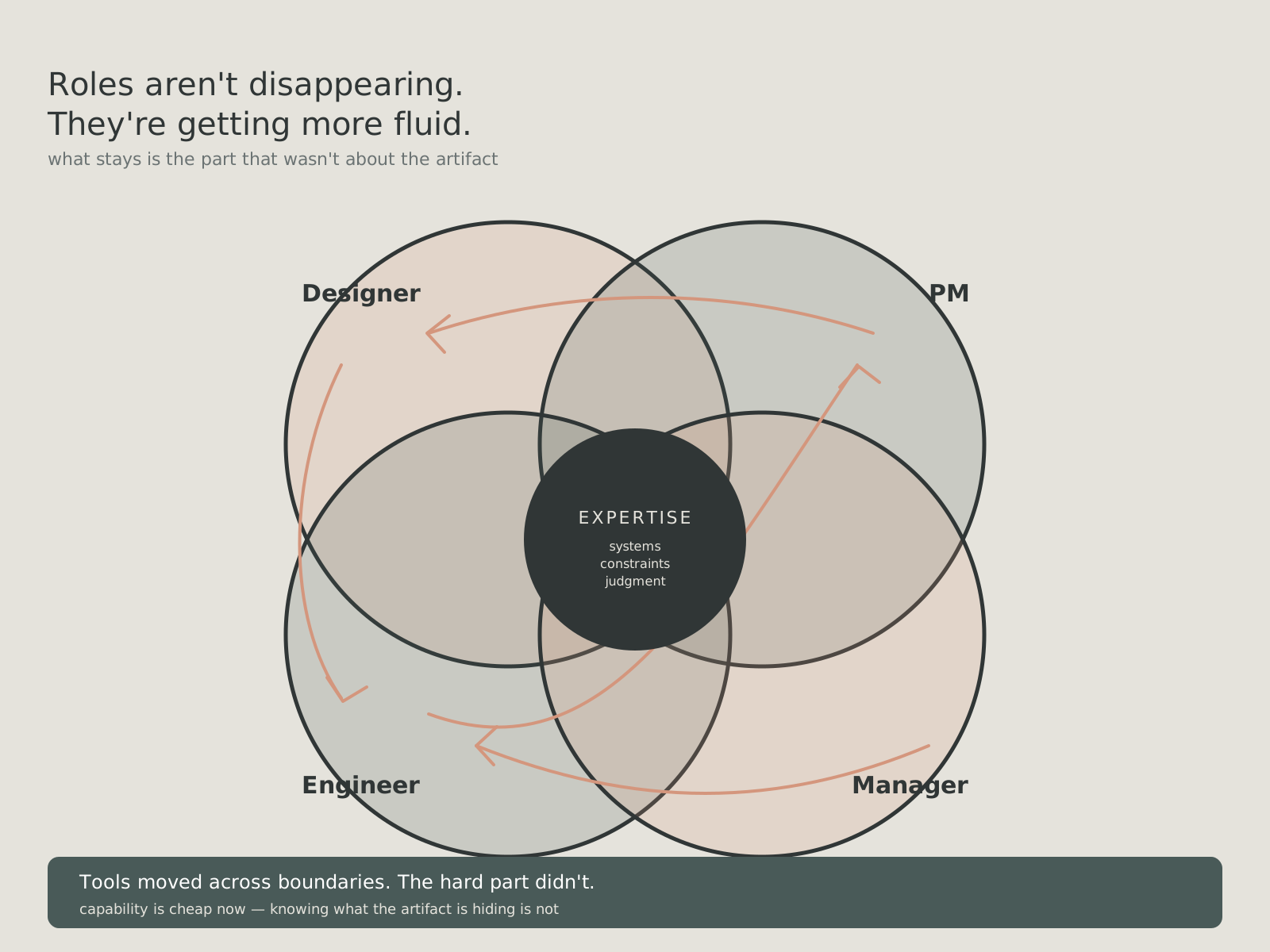
One thing I did not expect from AI was how quickly it would make me question where roles begin and end. Not because jobs suddenly disappeared or because designers became engineers overnight, but because I keep seeing work move across boundaries that used to feel more defined.
Designers are creating coded prototypes. PMs are building small tools. Developers are creating specs and mockups. Managers are experimenting with vibe coding. What once felt like occasional exceptions now feels increasingly normal, and I understand why. There is something powerful about reducing friction. A PM can test an idea sooner. A designer can explore behavior without waiting for engineering support. An engineer can quickly communicate an interaction instead of waiting for a dedicated design cycle. Work moves, people get unblocked, and ideas become cheaper to explore.
I see the value in that. I do not want to be cynical about it because there is real momentum in being able to move from thought to artifact more quickly. At the same time, I do not think we should pretend the tradeoffs are small. Specialization existed for a reason. It created accountability, expertise, quality control, and a clearer sense of who is responsible for what. While reality was always messier than job descriptions suggest, those boundaries helped teams know when to move fast and when to bring in the right judgment.
What complicates this further is that increased capability does not automatically produce better outcomes. I have seen developers prototype, PMs prototype, and designers move from Figma into coded prototypes. Some of these experiments are genuinely useful. Others feel cluttered, noisy, difficult to use, or strangely generic. What I found interesting is that the problems often look familiar. If the thinking was unclear in Figma, moving to code rarely fixed it. If hierarchy was confusing before, interactions rarely solved it. If systems thinking was missing earlier, the new medium often only made the problem more visible.
This is what made me reconsider what AI is actually changing. Perhaps the interesting shift is not that roles are disappearing, but that strengths and weaknesses become easier to amplify. Creating artifacts has never simply been about producing screens, prototypes, code, documentation, or prompts. Those are outputs. The harder work has always been understanding systems, constraints, accessibility, tradeoffs, interactions, customer problems, and knowing when something should exist at all.
I notice this in my own process too. Sometimes I prototype earlier because behavior communicates ideas better than static screens — that is where something like the Demo Days 0 to 14 Time-Machine Playbook earns its keep, because the artifact only helps if it can honestly show progression, not a single polished moment. Sometimes I start from systems and components rather than interfaces. Sometimes I use AI to explore directions faster. Sometimes I avoid it entirely because the work needs slower thinking first. None of this makes me feel like design is disappearing, but it does make me think expertise may look different than it used to. The craft becomes less about who can produce the artifact and more about who knows what the artifact is hiding — which is partly why I keep writing patterns like the Secret Handshakes for Designers Playbook: the tooling is cheap now, but the judgment about what to demo, in what state, to whom is not.
Perhaps specialization is not disappearing. Perhaps it is moving. And perhaps the harder question is not where roles begin and end, but how we preserve expertise while making work more fluid.
Related writing
-
Learnings
AI Changed How I Think About Design Artifacts
As AI moves from output generator to collaborator, the quality of our artifacts depends less on visual polish and more on structural clarity.
-
Learnings
Building Complex Products Made Me Think Differently About Solutions and User Journeys
How organizations naturally organize around solutions and ownership, why customers never experience products that way, and what that gap keeps asking of the journey.
-
Opinion
Visibility Is Valuable Until Customers Need to Move
A note on how products evolve from surfacing information to driving action — and why every step in that progression is gated by trust, not capability.